 BaoBao Talk
Mandarin for complete beginners
Chinese characters look arbitrary. They are not.
BaoBao Talk turns every character into a scene you can picture, built from its own sound and tone. It is the memory palace technique, already written for you, on top of a complete HSK 1 course.
- 74 building blocks
- 300 characters
- 28 themed units
- Free to start
The method
A memory palace for Hanzi
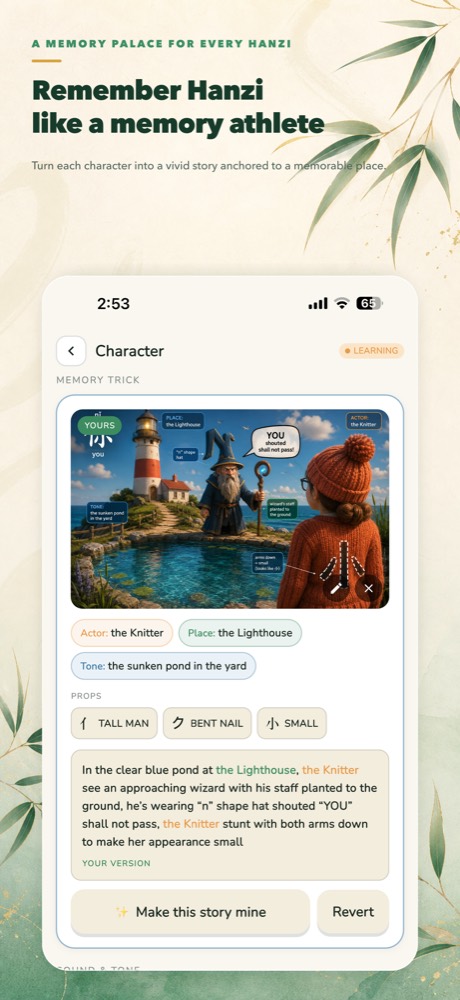
Memory athletes do not memorise raw lists. They put things somewhere, with someone, doing something, because a scene is far easier to recall than a symbol. Chinese characters take to this unusually well, because the sound of a character can decide who is in the scene and where it happens.
An actor for the sound
How a character starts decides who appears in it. Every w- character stars the Wolf. Learn 55 actors once and you have the first half of the pronunciation of every character you will ever meet.
A place for the ending
How the character ends decides where the scene happens. Anything ending -ao plays out at the Owl Sanctuary. 14 places cover them all.
A setting for the tone
The tone colours the scene: third tone is always the sunken pond in the yard. The tone is stored inside the picture, not bolted on as a number you forget.
What that looks like for one character
Take 好, hǎo, meaning good. h- brings the Hunter. -ao sets it at the Owl Sanctuary. Third tone puts it waist-deep in the sunken pond. So: waist-deep in the Owl Sanctuary pond, the Hunter lifts a child up to a laughing woman, and she is good with him. The parts of the character are in the scene, and so are its sound and its tone.
Every one of the 300 characters already has a scene written for it. You are not asked to invent 300 stories: you edit the ones that do not fit, rename any actor to someone you know, and add your own picture where it helps.
74 parts is a fixed cost. Characters are not. Learn the parts once and the hundredth character costs less effort than the tenth, which is the opposite of how rote memorisation goes.
Why it works
Built on how memory actually behaves
Three findings from learning science do most of the heavy lifting. The app applies them for you, so you never have to design a study plan.
Spaced repetition
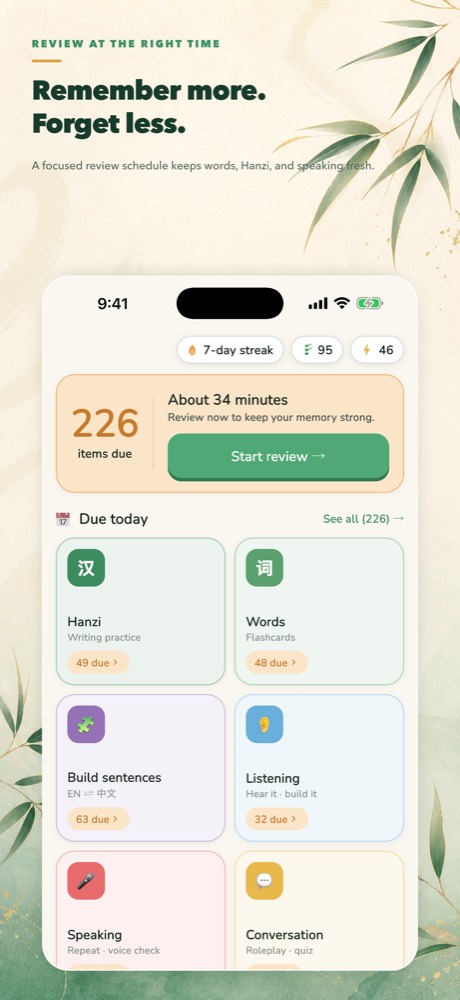
Reviews are scheduled by FSRS, a modern version of the algorithm behind Anki. Each character comes back at the widest gap you can still recall it at, so you revise less and remember more.
Active recall
Every exercise makes you produce the answer, trace the strokes, build the sentence, say the line, instead of recognising it on a flashcard. Retrieval is what forms the memory.
Sound before script
Tones are trained from day one with native recordings and minimal pairs, because a character learned without its tone is a habit you have to unlearn later.
Inside the app
One app instead of five
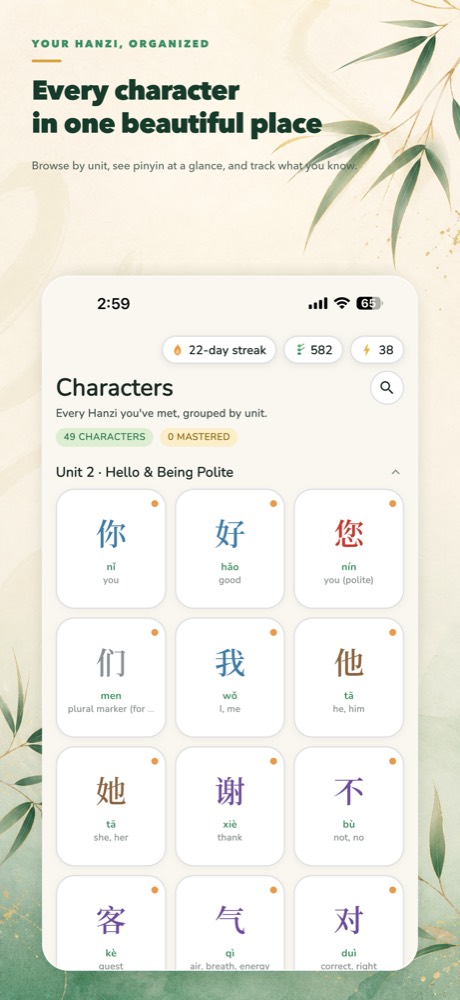
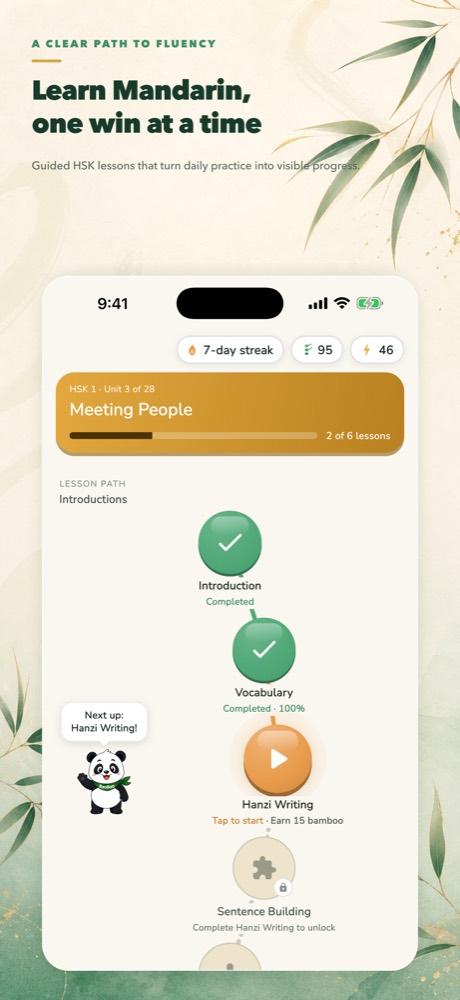
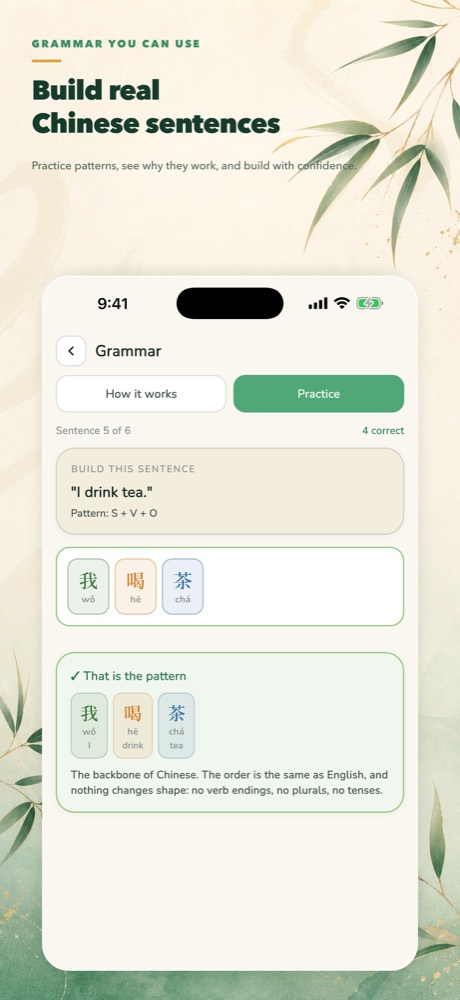
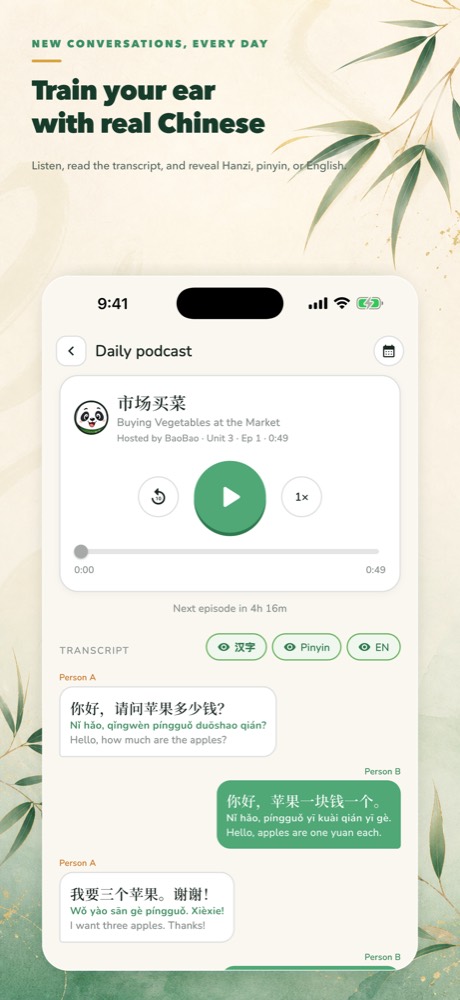
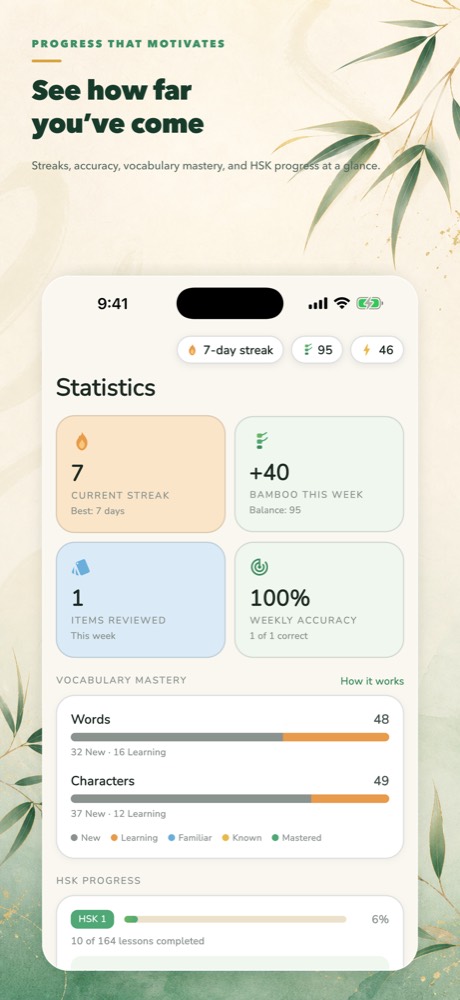
A memory system, a course, a stroke trainer, a pinyin lab, a review scheduler and a listening habit, all sharing the same progress.
How it works
Your first month, step by step
Start with sound, not characters
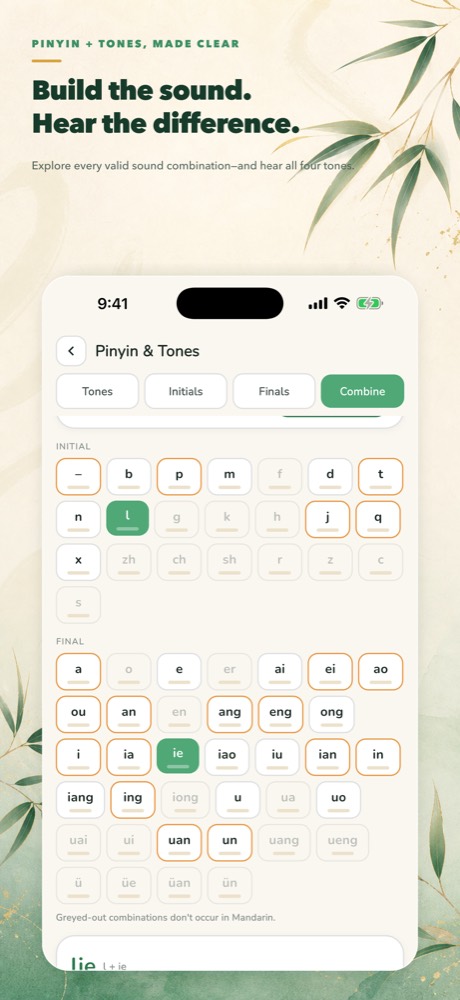
Unit 1 is pinyin and the four tones. You hear mā má mǎ mà until you can tell them apart, because every character you meet later hangs on that hook.
Learn a unit's words in context
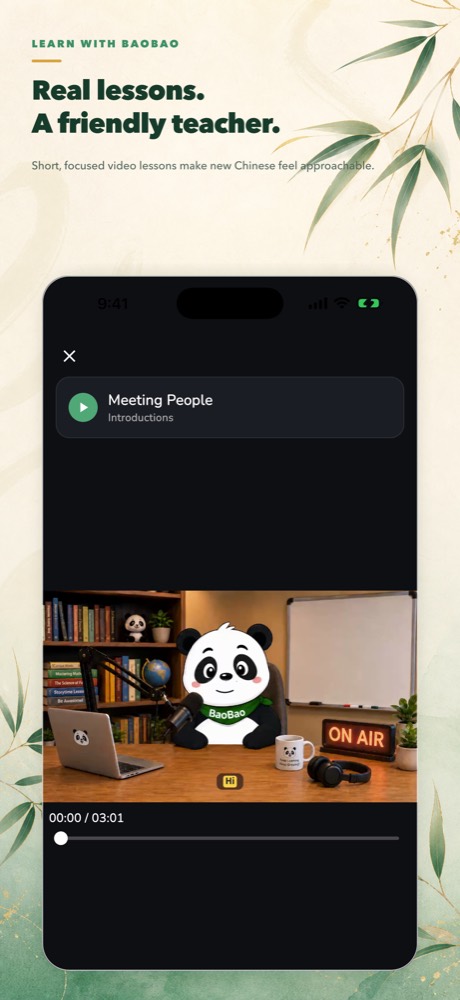
Each unit opens with a short video, then vocabulary, stroke practice, sentence building and a conversation, all built from the same 10 to 15 words, so nothing arrives out of nowhere.
Trace every character
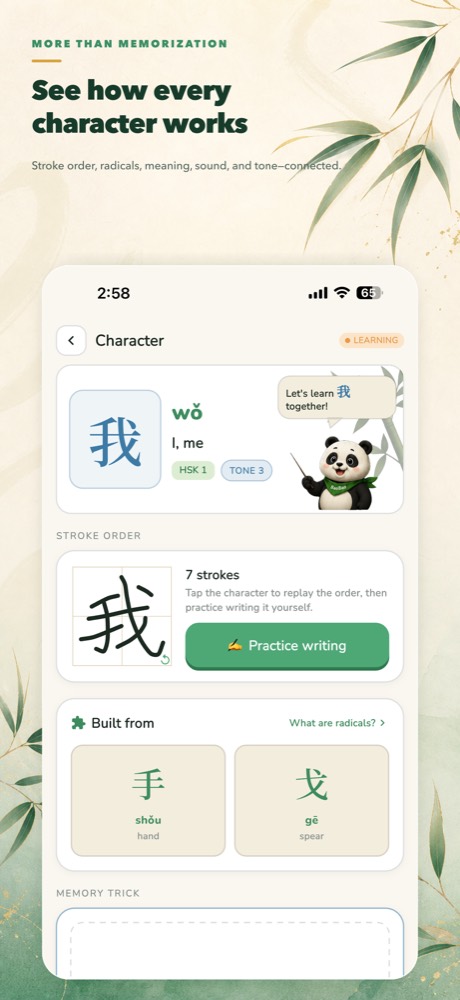
The correct stroke order animates once, then you write it. Getting the order into your hand is what stops 找 and 我 blurring together.
Say it out loud
Speaking exercises listen through your phone and show what they heard in characters and pinyin, so you can hear the gap between what you meant and what came out.
Let reviews come to you
Everything you have learned enters a queue scheduled by FSRS. Open the Review tab, clear what is due, and the algorithm handles the rest for the next month.
Listen to a new episode daily
A two-minute dialogue, written to use only the vocabulary you have already met, arrives each day. It is the fastest way to turn recognition into comprehension.
Free guides
Learn the method, not just the app
Straight answers to the questions every beginner hits in their first month, and how to put each one into practice.
How to learn Chinese characters
Why rote copying fails, what to do instead, and how many to take on per day.
HSK 1 character list
How many characters HSK 1 really needs under HSK 2.0 and 3.0, and where to start.
How to practise Chinese tones
The four tones, why tone pairs are the hard part, and a daily ear-training routine.
Chinese stroke order rules
The seven rules that cover almost every character, with worked examples.
How long does it take to learn Chinese?
Honest hour counts for HSK 1 through HSK 3, and what actually moves the number.
Spaced repetition for Chinese
What FSRS does, why intervals grow, and how to stop a review backlog forming.
Pinyin chart: initials and finals
Every initial and final, the sounds English speakers get wrong, and how to drill them.
How to practise speaking alone
Getting fluent without a tutor, using shadowing and speech recognition.
Chinese listening practice for beginners
Why native content is too hard at first, and what comprehensible input looks like.
How to study for the HSK 1 exam
The exam format, a realistic eight-week plan, and how to know you are ready.
Questions
Frequently asked
How many Chinese characters do I need for HSK 1?
HSK 3.0 Level 1 expects roughly 300 characters for reading, with a smaller subset you should be able to handwrite. The older HSK 2.0 standard asked for about 150. BaoBao Talk teaches 300 across 28 units, so you are covered under either standard.
How long does it take to learn HSK 1?
Published estimates cluster around 80 to 150 hours for a complete beginner, which is two to three months at 15 minutes a day plus reviews. Daily consistency beats long weekend sessions, because the review schedule depends on regular contact.
Can I really learn Chinese tones from an app?
You can, provided the app makes you listen and speak rather than read explanations. Tones are a perception skill first: you have to hear the difference before you can produce it. BaoBao Talk drills all four tones and the neutral tone with native recordings and scores what you say back.
Do I need to write characters by hand?
Not to pass HSK 1, which is typed or multiple choice. But tracing strokes is one of the cheapest ways to stop similar characters blurring together, and it takes seconds per character.
What is spaced repetition, and why does it matter?
It schedules each item to reappear just before you would forget it. The gap widens every time you succeed, so a character you know well might not return for months while a shaky one comes back tomorrow. BaoBao Talk uses FSRS and decides the timing for you.
Can I practise speaking without a partner?
Yes. Speaking exercises use your phone's built-in speech recognition, then show what it heard as characters and pinyin so you can compare it with the target line. Nobody else needs to be in the room.
Where do I start if I know absolutely nothing?
With pinyin and the tones, before any characters. Pinyin is the spelling system for Mandarin sounds; once you can read it, every new word has a pronunciation you can trust.
Is BaoBao Talk free?
The course is free to start and stays usable at a steady daily pace. BaoBao Plus lifts the daily practice limit and opens the whole course; monthly and yearly plans both start with a free trial, and you can cancel from your Apple ID settings at any time.
Does it work offline?
Lessons you have already opened remain available and your progress syncs when you are back online. Audio, unit videos and the daily podcast episode need a connection the first time you play them.
Is this useful if I already studied some Chinese?
If you can already read a few hundred characters comfortably, HSK 1 will be revision. It is built for people from zero to the end of their first level, including anyone who started before and stalled.
Your first character is five minutes away
Free to start, no ads, and a course that knows what to show you next. Download BaoBao Talk and finish HSK 1 this quarter.